

Beyond the Ache: Reclaiming Your Alignment from Tech Neck


In our hyper-digital era, we are more connected than ever—and yet, physically, we’ve never been more “bent out of shape.” If you’ve felt a persistent ache at the base of your skull or a heaviness across your shoulders, you aren’t just experiencing a minor inconvenience; you are witnessing the physical manifestation of our modern lives: Tech Neck.
As a licensed massage therapist in Indiana, I see this daily. At my home base, Soul Trine, my business partner Krysten and I specialize in targeted deep tissue work to address these physical blocks. Our approach integrates notes Somatic Regulation—the practice of using movement, breath, and awareness to help your nervous system feel safe enough to release long-held patterns of tension. Somatic Regulation sessions that focus solely on movement, breath, and awareness can be booked with me separately.
The Structural Danger: More Than Just a Sore Neck
“Tech Neck” (or text neck) is not just a buzzword; it is a repetitive stress injury that can lead to permanent structural changes in the spine. When we are hunched over our devices, we lose the natural “C-curve” of the cervical spine, a condition known as cervical kyphosis. This loss of curvature doesn’t just stay in the neck; it creates a “global” collapse in the body’s kinetic chain, often leading to reduced lung capacity by up to 30% due to the compression of the chest and diaphragm.
Degenerative Impact: Chronic forward head posture is a leading contributor to premature spinal degeneration, disc herniation, and nerve impingement. (Source: Journal of Physical Therapy Science)
The Weight of the World: Our heads average about 10 to 12 pounds in a neutral position. However, physics is a demanding landlord. For every inch you tilt your head forward, the effective weight on your spine doubles. At a 60-degree angle, your neck muscles are straining to hold up the equivalent of 60 pounds. (Source: Surgical Technology International)
This constant “on” state leads to micro-tears, inflammation, and a nervous system stuck in a protective “fight or flight” loop. Essentially, your muscles are bracing for a threat that never leaves.
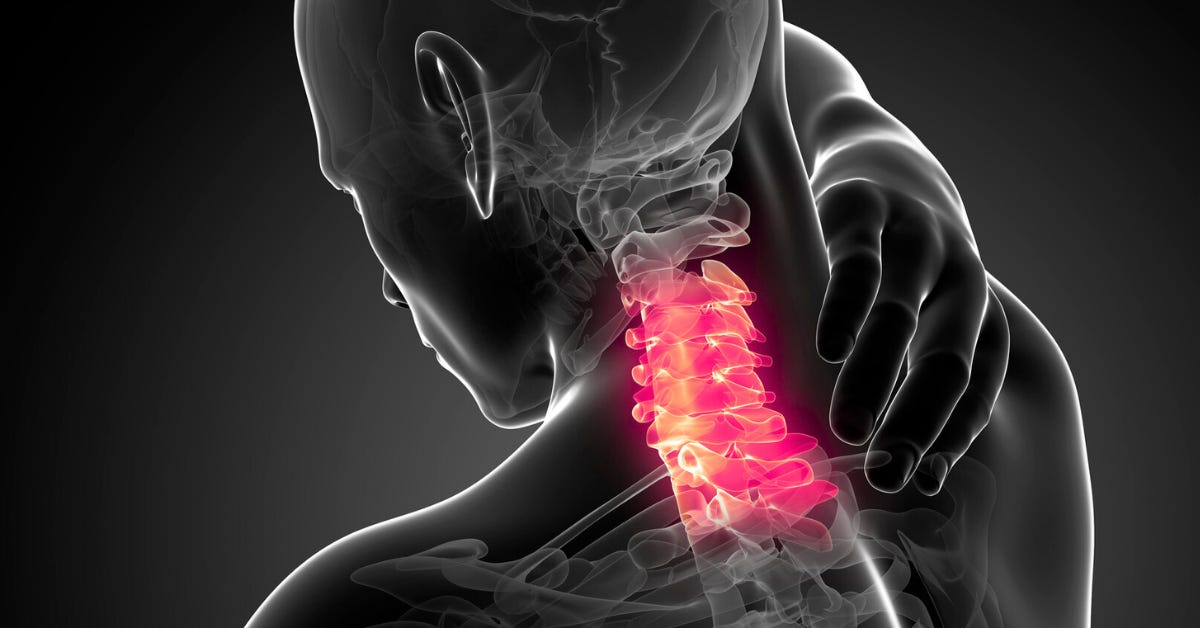
Side Note: I have a few clients who provide post-surgery support for people who have head, neck, and spinal surgeries. They are telling me that the people who typically need that surgery are usually in their 60s and older. These days, they are supporting an increasing number of people in their 30s who require this surgery due to prolonged desk work and excessive mobile device usage.
Why Deep Tissue is the “Reset” Button
Deep tissue massage is more than just pressure; it is a clinical conversation with your fascia and nervous system. Whether you are working with Krysten or myself, we prioritize these mechanical and neurological resets:
Breaking the Adhesion Cycle: Chronic strain causes the body to produce collagen fibers to “brace” the area, creating fascial adhesions (knots). Deep tissue uses slow, intentional sinking into the myofascial layers to create “frictional heat,” allowing these fibers to realign.
The Evidence: Research indicates that deep tissue work significantly increases the range of motion and decreases pain by improving blood flow to oxygen-starved tissues. (Source: Journal of Physical Therapy Science)

“I’m too sensitive for deep tissue. What can I do to relieve this pain?”
This is a concern I hear often, usually from clients who have been “beat up” by high-pressure sessions with past therapists. It is important to distinguish Deep Tissue (accessing the underlying layers of musculature) from Deep Pressure (intensity of force).
If your nervous system is in a state of high alert, “muscling through” the pain will only cause your body to brace harder. For my clients who want to go another route, we use Cupping or the Magnesium Heat Treatment to “invite” the tissue to open up rather than forcing it. These tools allow us to achieve deep, structural results without triggering a pain response.
Targeted Relief: Complimentary Cupping for Shoulder Tension
At Soul Trine, we believe in providing every tool necessary for your recovery, which is why cupping is always complimentary with your session.
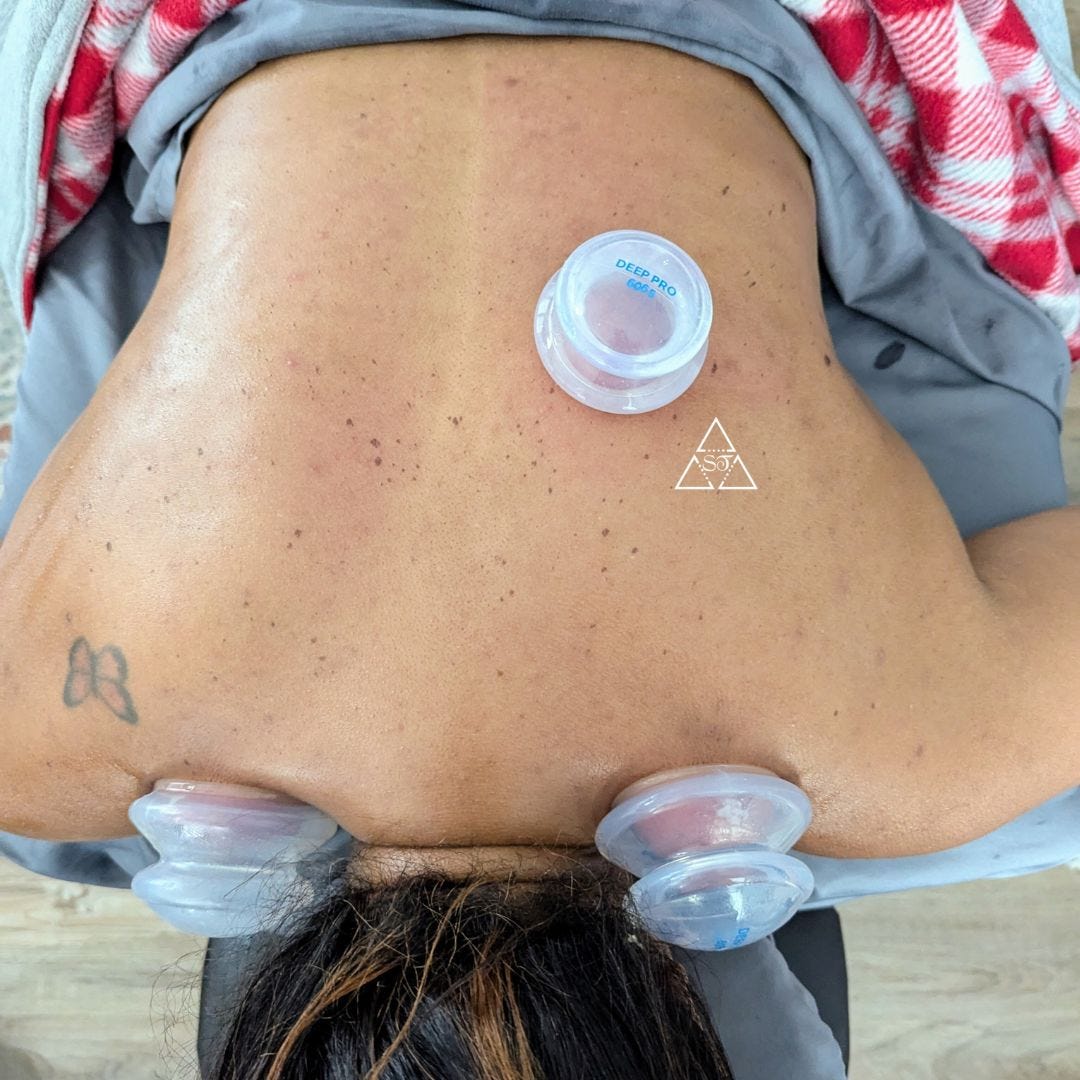
While we never apply suction directly to the delicate structures of the neck—due to the proximity of vital blood vessels—we utilize cupping on the shoulders and upper back. Because the muscles that govern the neck (like the trapezius and levator scapulae) originate in the shoulders, releasing the “anchor” provides immediate relief to the neck itself.
How it Works: Cupping creates negative pressure, lifting the skin and fascia away from the muscle. This increases local circulation and helps “flush” the metabolic waste that accumulates during long hours at a desk.
The Evidence: Randomized controlled trials have shown that cupping therapy is highly effective in relieving chronic neck and shoulder pain. (Source: Evidence-Based Complementary and Alternative Medicine)
Deep Unwinding: The Magnesium Heat Treatment Add-On
To further support the “unwinding” process, we offer the Magnesium Heat Treatment as a specialized add-on. This combination is specifically designed to melt away the stubborn rigidity that keeps you trapped in a forward-leaning posture.
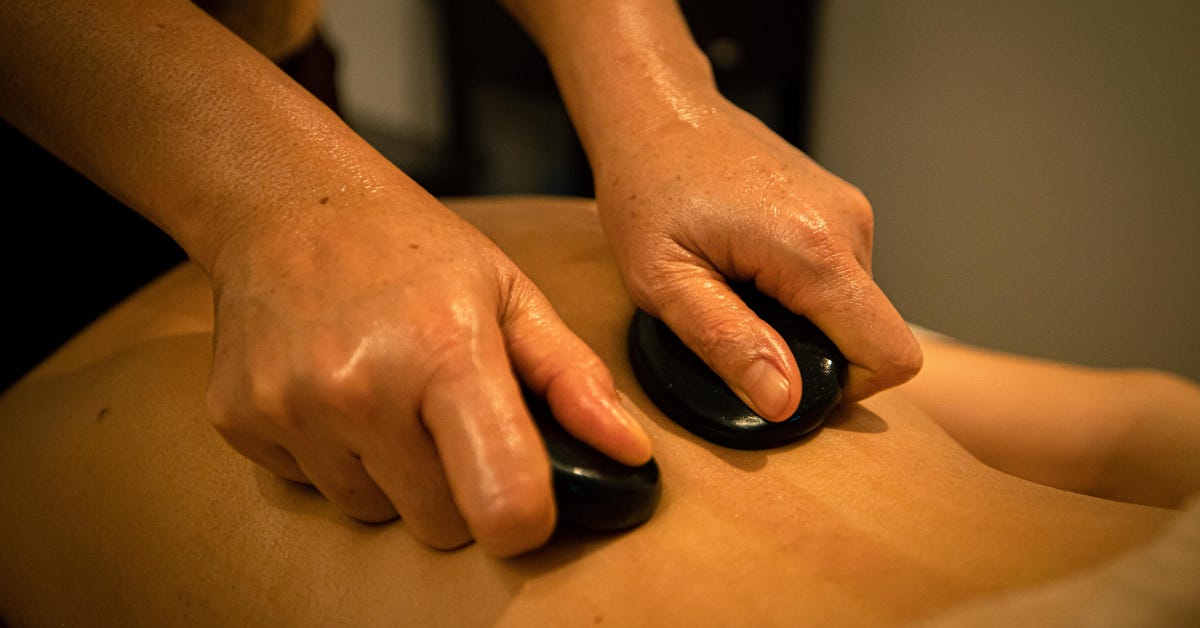
In this treatment, we use a high-quality magnesium cream paired with the grounding, penetrative warmth of hot stones. The heat from the stones helps the magnesium penetrate deeper into the muscle fibers, addressing the chemical and physical roots of your tension simultaneously.
Therapeutic Heat: Heat dilates blood vessels, enhancing the flow of oxygen to damaged tissues. This “gate control” mechanism can block pain signals from reaching the brain. (Source: Arthritis Foundation - Heat Therapy)
Magnesium—The Relaxation Mineral: Magnesium is essential for muscle relaxation. When applied topically (transdermally) during your treatment, it helps soothe local muscle spasms and “quiet” a hyperactive nervous system.
Self-Care Tip: If you want to bring this relief home, I highly recommend using the same magnesium cream I use in the studio. You can find it here.
Somatic Resets: Re-educating the Body
Between our sessions at Soul Trine, I want you to reclaim your space. While the following movements may look like standard stretches, I invite you to approach them as Somatic Resets.
The difference lies in your awareness. In stretching, we often force a muscle to change. In somatics, we are re-educating the brain. Tech Neck puts the body in a “startle response”—a protective, closed-off posture. By moving slowly and focusing on the internal sensation (interoception), we signal to the nervous system that the “threat” is over.
The Heart Opener (Doorway Stretch): Stand in a doorway with arms at 90-degree angles. Lean forward gently. Instead of “pulling” the muscle, breathe into the space in your chest. Notice the sensation of your heart center unfurling from its protective shell.
The Chin Tuck: While sitting tall, gently draw your chin straight back. This isn’t just a neck movement; it’s a recalibration of your internal “GPS,” reminding your brain where your head belongs in relation to your spine.
The Somatic Breath: As you move, take a deep belly breath. Visualize the tension leaving your neck and grounding into the earth. This breath is the bridge that carries you from a state of “high alert” back into your body.
Schedule Your Massage or Somatic Regulation Session.
Finding Your “Center”
You don’t have to live in a body that feels like a cage. Whether we are working through deep myofascial release with Krysten or myself, applying the soothing pull of cups, or using our targeted Magnesium Heat Treatment add-on to quiet your nerves, the goal is the same: Alignment.
If you’re ready to put down the weight of the digital world and return to your body, we’d love to see you on our table.